Rambu Solo' Funeral in Toraja: A Guest's Guide to Attending
How to attend a Toraja funeral as an introduced guest: the gift, the clothes, the buffalo rites, the season, and the two mistakes visitors make.
Budaya10 menit baca
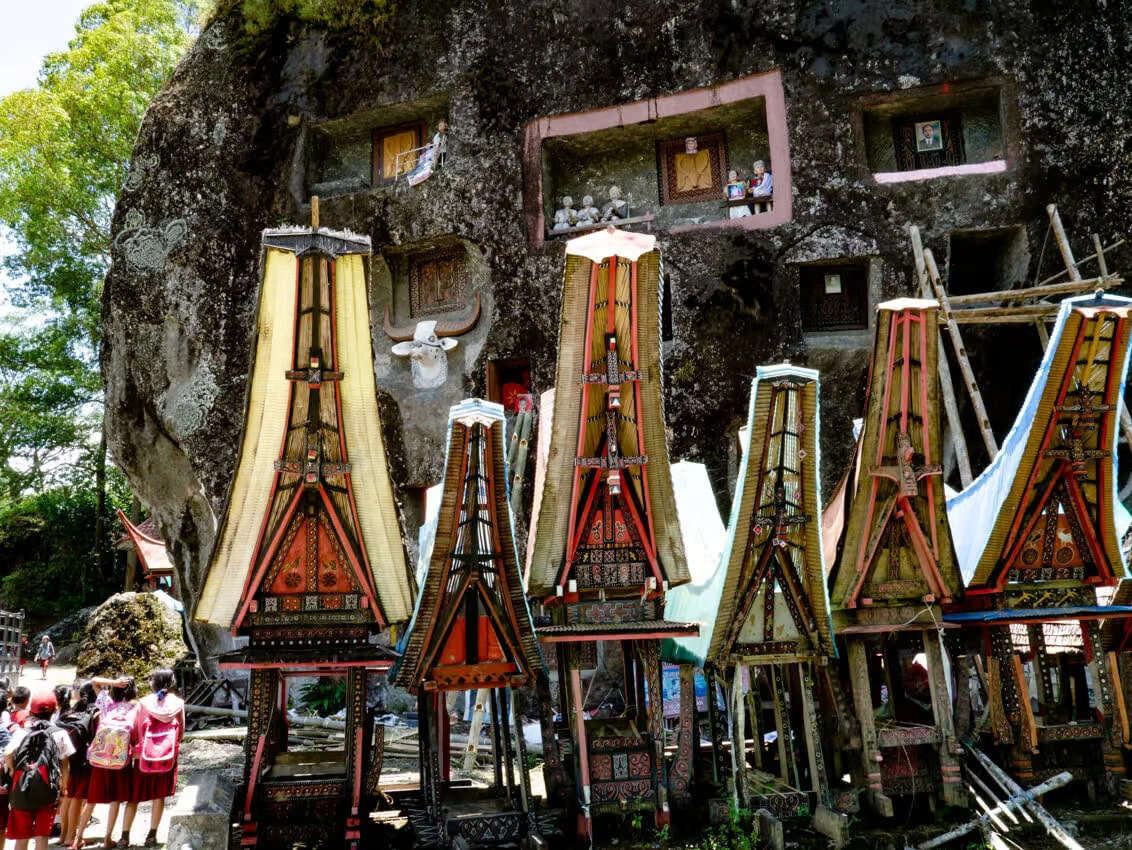
Foreign visitors can attend a Rambu Solo' funeral in Tana Toraja if someone introduces them. Bring a small gift and let your guide hand it over. Wear dark clothes. Sit on the visitor platforms when the family offers a place. Stay out of the inner ring while the family presents and kills the buffalo. You may take photos, but not of the body, and not of the family during the slaughter.
A funeral that does not look like one
To an outsider, the event hardly seems like a funeral. The death often happened months or even years earlier. Since then, the body has rested in a wrapped bundle inside the family's tongkonan house. Relatives treat the person as ill, not dead. They call the person to makula', "the one with fever". This continues until the family can pay for the ceremony.
Once the family sets a date, hundreds of guests arrive in the village. Buffalo die. Singing lasts all night. Children climb the bamboo towers to watch. By the second day, many foreign guests feel the family has given them more hospitality than they deserve.
The ceremony and its days
Rambu Solo' is the full funeral for a Torajan of standing. That may be a clan elder, a prosperous farmer or anyone whose family can gather enough buffalo, rice and relatives.
The scale depends on the family:
- A smaller family completes the funeral in one day.
- A larger family builds platforms, receives hundreds of guests and spreads the ceremony over four to seven days.
Each day has its own purpose. One day receives guests. Another presents the buffalo. Others hold the ma'pasilaga tedong, the buffalo fight, then the slaughter, and finally the procession to the cliff grave.
The slaughter
This is the part most outsiders find hardest. A butcher chosen by the village kills each buffalo with one cut to the throat. The family then shares out the meat among the guests in a fixed order of family rank. You do not have to watch. You may also leave the ceremony ground while it happens. You must not talk during it.
How to get in
No written invitation is needed. An introduction is. Every guide in Rantepao belongs to a clan. In the high season, most clans are either holding a Rambu Solo' or going to one. On the day you arrive, tell your guesthouse you would like to attend. Staff there know which funerals are on and who can bring you.
The gift
The usual gift is a carton of kretek cigarettes or a bottle of palm wine. A carton cost about €19 in 2026. The family does not expect money. Your guide carries the gift to the family when you arrive, so you never hand it over yourself. If the family keeps a guest book, your name goes in it.
Dress and what to carry
- Colour. Wear black if you can. Navy or dark brown also works. Avoid white and bright patterns.
- Cover. Wear long sleeves and long trousers, even in the heat. Cover your shoulders.
- For women. Hosts see a wrap skirt worn over trousers as a sign of respect. A head scarf is appreciated during the walk to the grave but not required.
- Bring water, a hat and a small notebook.
- Leave at home perfume or cologne, big bags and any device that beeps or buzzes.
Using a camera
Turn off the shutter sound. Stay seated while you shoot. Never photograph the body, even when it is wrapped. Never photograph the family during the slaughter.
A typical day at the funeral
Morning: welcome. Staff seat you on the lantang, guest platforms built along the sides for this ceremony alone. The family takes them down afterwards. Coffee and palm wine arrive. When members of the host family walk past, stand up for a moment.
Late morning: the buffalo. Men lead the animals across the ground. People judge their value, and then the animals are tied. Sometimes two buffalo fight. The contest is formal, and it ends when one animal turns away. Stay outside the inner ring while this happens.
Late afternoon: the slaughter. See the section above.
Evening: meat and a meal. The family shares out the meat, and a long meal follows. At some funerals, singing and the ma'badong circle chant continue all night. Guests may stay. Most visitors go home around dusk.
Final day: the procession. Villagers carry the wrapped body up a steep bamboo frame to the cliff grave. The climb can last an hour. Local people carry the body. Visitors watch from the ground.
Two common mistakes
Leaving without a word
Many foreign guests slip away in the afternoon so they do not impose. Do not do this. A silent departure looks rude. Find your guide. The guide finds the relative who welcomed you. Say thank you and bow slightly. The family expects it.
Waving away the palm wine
Ballo, the local palm wine, is a sign of welcome. It contains a little alcohol. The best answer is to take a small sip and say thank you. You may refuse, but do it clearly: look the host in the eye and shake your head once. Do not brush the glass away with your hand.
Funeral season
Most funerals take place from June to September. By then the rice harvest is finished, and the wider family has time to come together. December is a second busy period. At other times, funerals are fewer and smaller. You might still find one in April or May. In July, a Rantepao guide can almost always find one. In April, a guide cannot make that promise.